Buying your first home? Start with a budget

With the right budgeting game plan, you can take steps toward homeownership.

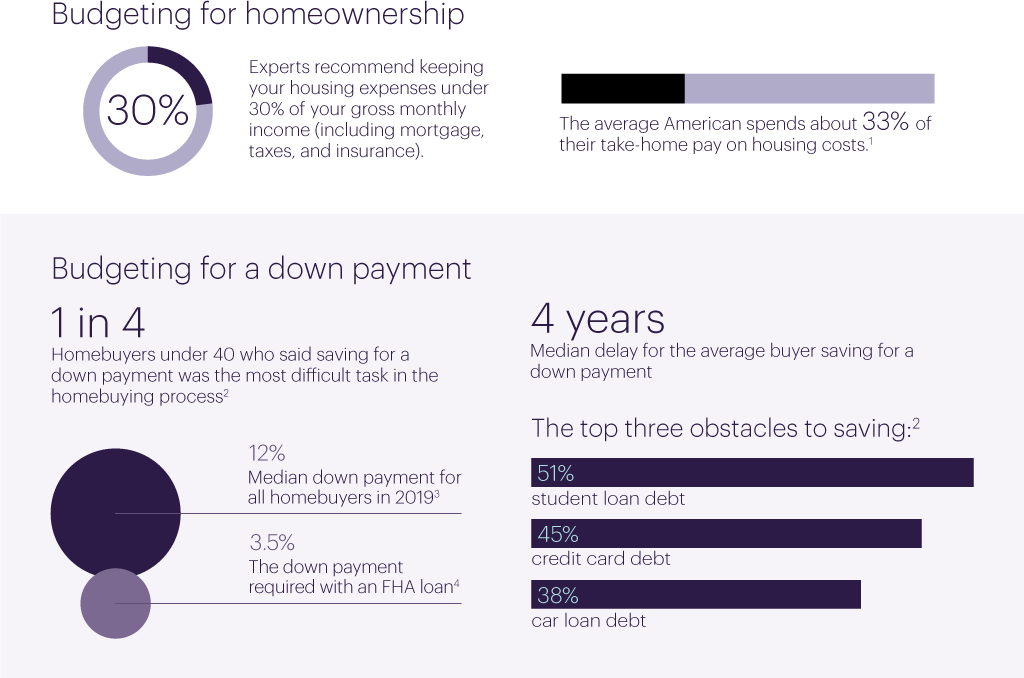
Budgeting for homeownership  Experts recommend keeping housing expenses under 30% of gross monthly income, including mortgage, taxes, and insurance. The average American spends about 33% of take-home pay on housing costs.  Budgeting for a down payment  1 in 4 homebuyers under age 40 said saving for a down payment was the most difficult task in the homebuying process. 4 years is the median delay for the average buyer saving for a down payment. 12% median down payment for all homebuyers in 2019. 3.5% down payment required with an FHA loan.  Top three obstacles to saving:  51% – Student loan debt 45% – Credit card debt 38% – Car loan debt

Budgeting for closing costs5

$5,749

Average national closing cost for a single-family property, including taxes

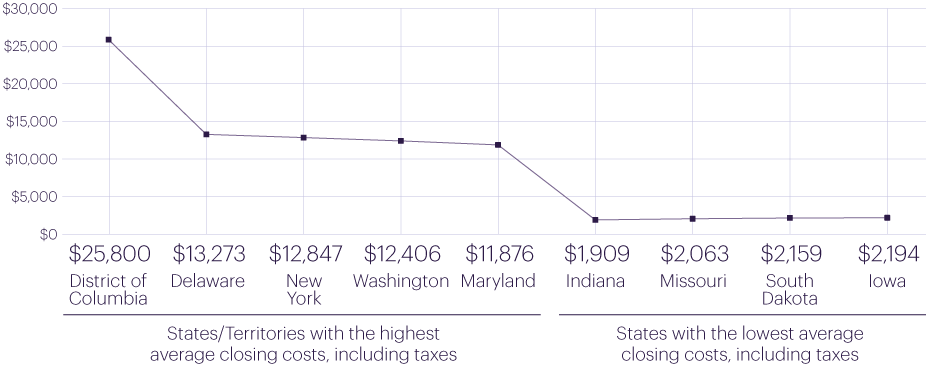
Budgeting for Closing Costs  $5,749  Average national closing cost for a single-family property, including taxes.  States/Territories with the Highest Average Closing Costs (including taxes):  District of Columbia: $25,800 Delaware: $13,273 New York: $12,847 Washington: $12,406 Maryland: $11,876  States with the Lowest Average Closing Costs (including taxes):  Indiana: $1,909 Missouri: $2,063 South Dakota: $2,159 Iowa: $2,194

Setting up for homebuying success

Three simple money-management steps can help keep your home buying plans on track.

Step 1

Reduce debt and save

  • Stay current on your debt payments and pay down debts where you can. This may improve your credit score.
  • Set up a recurring transfer for every pay period to make saving for a home easier.

Step 2

Determine your spending limit

  • Calculate 30% of your gross monthly household income to help determine how much you can afford to spend on housing expenses. 
  • Get preapproved for a home loan, if possible, and research mortgage rates.

Step 3

Plan for additional costsDisclosure 6

  • Ask your real estate agent for projected utility costs for homes in your price range.
  • Budget 1% to 2% of your home’s value each year for repairs and maintenance.
  • Add closing costs into your budget—an average of 2% to 5% of your home’s purchase price.
  • Consider other housing expenses such as homeowners insurance, association fees, and property taxes. Private mortgage insurance may be required if your down payment is less than 20% of your home’s cost.

Buying a home is an exciting milestone that starts with creating a budget that fits your lifestyle. Be in control of your budget from the start so you can conquer the homebuying process with confidence.

1 “A Look at the Average American Budget – and How the Average American Can Start Saving More,” Aug. 24, 2020, The Simple Dollar

2 “Home Buyer and Seller Generational Trends Report,” March 2020, National Association of Realtors

3 "2020 Downpayment Expectations & Hurdles to Homeownership,” April 2020, National Association of Realtors

4 “Federal Housing Administration Loan,” Oct. 26, 2020, Investopedia

5 “ClosingCorp Reports Average Mortgage Closing Cost Data for 2019,” April 1, 2020, ClosingCorp

6 “5 Expenses That Shock First-Time Homebuyers,” Feb. 8, 2021, The Balance

Related resources

    {0}
    {6}
    {7}
    {8}
    {9}
    {12}
    {10}
    {11}

    {3}

    {1}
    {2}
    {7}
    {8}
    {9}
    {10}
    {11}
    {14}
    {12}
    {13}