Industry Expertise

Strategic shifts reshaping Transportation & Logistics

Automation, diversified services, and flexible capacity strategies help logistics firms adapt

Ramona Burada is the Transportation & Logistics (T&L) Industry Specialist for Truist.

The start of 2026 finds the T&L industry transitioning from a year marked by mixed signals. While 2025 did not deliver the anticipated demand rebound, ongoing shifts in the economic and industry landscape created a complex environment for planning and performance expectations.

Mike Skordeles, Head of U.S. Economics for Truist Advisory Services, Inc., describes the overall economy as having “muddled through” the second half of 2025. The U.S. economy has managed to avoid major downturns and maintained generally solid business conditions, though with reduced visibility and increased variability. The Transportation & Logistics sector has experienced similar dynamics.

It won’t be easy for the T&L industry to shake its wariness of softer demand, economic uncertainty, tariffs, trade shifts, geopolitical uncertainty, and regulatory pressures. Despite valid reasons for caution, technology, automation, and structural shifts in T&L services are creating new opportunities for companies positioned to recognize and act on them. As the new year begins, leaders are looking for these signals along with ways to help them optimize the timing of new investment and more confidently make long-term bets on the opportunities they uncover.

Growth under pressure

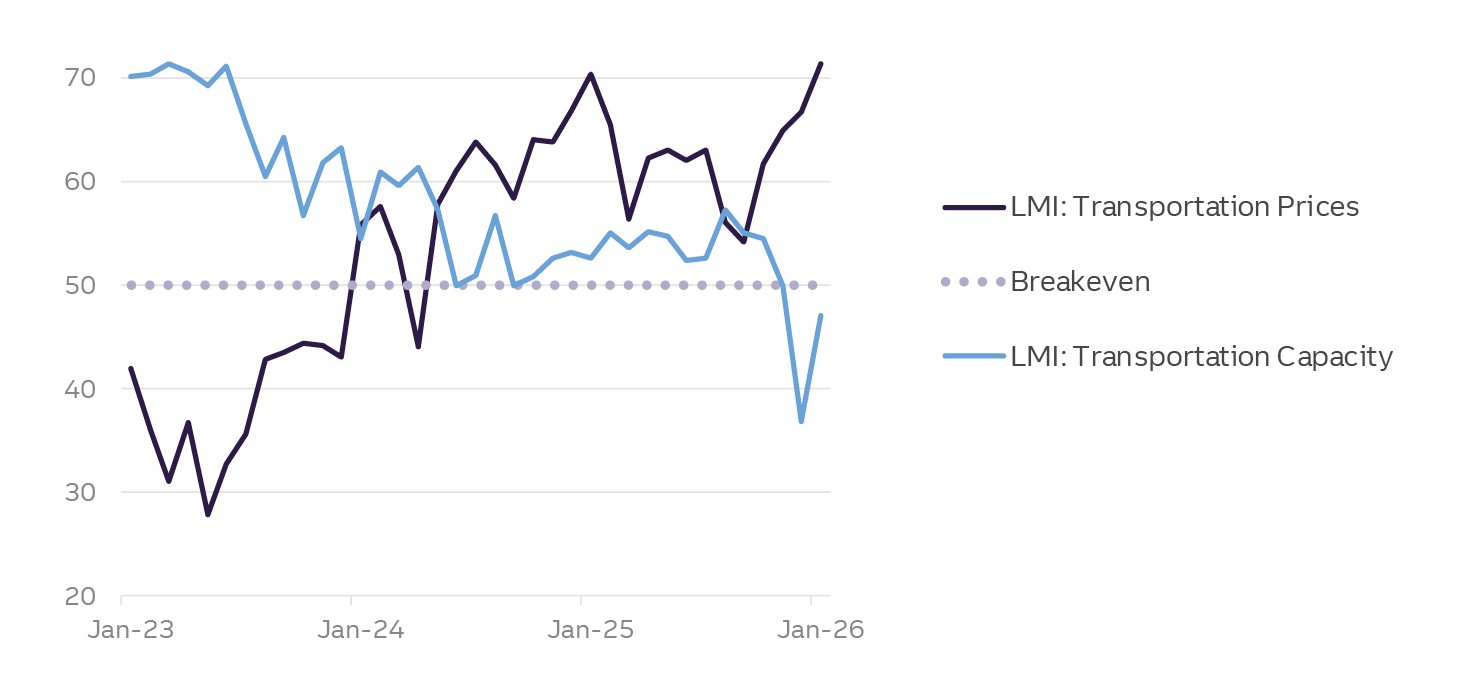
Despite upswings over the past two years, the Logistics Managers’ Index (LMI) has not consistently reached above 50, a level that would point to sustained growth for the industry. On a positive note, the Transportation Prices component has generally strengthened over the past year while the Transportation Capacity has tightened as businesses have worked to reduce the overcapacity that plagued the industry in the wake of the pandemic.Disclosure 1

LMI Transportation Pricing strengthens while Transportation Capacity tightens.

Line chart showing Logistics Managers’ Index transportation metrics from January 2023 to January 2026. Transportation Prices index (dark line) rises from the low-40s in early 2023 to above 70 by early 2026, moving well above the breakeven level of 50. Transportation Capacity index (light blue line) declines from about 70 in early 2023 to below 50 by early 2026, briefly dropping to the high-30s.

Looking forward, LMI survey respondents’ predictions about conditions a year from now (February 2027) show an overall index score of 66.4, 8% higher than the current LMI index. The Transportation Prices component is expected to rise above 80 behind extreme expansions in price. Expected increases in Transportation Utilization, Warehousing Utilization, Warehousing Prices, and Inventory Levels also pull the overall index higher.Disclosure 1

For this shift in the transportation market to take place, consumer demand will need to hold steady despite potential price increases. We’ve just witnessed stronger consumer demand than anticipated throughout 2025, so there is a chance that we’ll see the strengthening freight market that these future LMI Index levels suggest.

In an environment defined by slow but steady industry growth, operational efficiency, disciplined cost management, and strategic differentiation matter far more than chasing short‑term demand spikes.

Structural shifts

Rising demand is behind the continued growth of warehousing and distribution services, spurred in large part by e-commerce and the pursuit of “last mile” strategies as companies continue efforts to bring their inventories closer to consumers.

Among freight forwarders, a more defensive strategy dominates current industry thinking. This segment is under pressure, particularly in global air and ocean freight, as trade volumes soften and tariff-driven disruptions along with geopolitical tensions threaten stability. Forwarders are prioritizing risk mitigation over aggressive expansion, consolidating networks, renegotiating carrier contracts, and investing in digital visibility tools to maintain reliability.

In the domestic market, truckload spot rates have risen only modestly, and contract rates remain volatile.Disclosure 2 To offset margin pressure, industry players are diversifying into higher-value services such as warehousing, regional distribution, intermodal transport, integrated supply chain solutions, and other offerings that provide greater resilience and customer value.

Risks and headwinds

Chasing services and markets that are expected to grow is one strategy, but risk management should also factor in growth planning at this stage. Today there are several important risk factors shaping leaders’ strategic thinking:

Demand variability and trade volatility reduce visibility into long-term trends. Global economic instability, shifting trade and tariff policies, and ongoing geopolitical conflicts all contribute to difficult-to-predict freight demand.

Overcapacity is applying downward pressure on rates and margins. Capacity exceeds demand in many industry sectors, especially in freight forwarding and global shipping.

Regulatory and compliance pressures will raise costs and require capital investment.

Trucking firms face growing scrutiny around emissions, safety metrics, and advanced systems like speed monitoring and braking technology. At the same time, enforcement is tightening on driver qualifications.

The current softness in demand favors making selective, strategic capital investments that value future flexibility. Modular investments like scalable warehousing, incremental capacity increases, and technological upgrades prevail over aggressive fleet expansion.

In the current T&L market, operational efficiency, automation, and logistics technology are becoming the defining competitive advantages for companies positioned to recognize and act on them.

6 focus areas for T&L leaders

Guided by conservative expectations around volume growth, T&L firms are considering appropriate strategies that value flexibility. To help them prepare for future opportunities, leaders are focusing on:

  • Investing in advanced logistics technology and AI. Tools and skills that support digitization, automation, and AI will help T&L companies capture the efficiencies needed to compete in most future scenarios. In the spotlight are supply chain visibility, demand forecasting, dynamic routing, and warehouse automation. Investing in systems that allow real-time visibility adds flexibility to shift between air, rail, and road as needed and provide better outcomes for customers.
  • Expanding warehousing, distribution, and fulfillment services. Ramping up these capabilities—especially near high-demand population centers—helps support e-commerce, allows reverse logistics, and allows companies to meet faster delivery expectations. Truist can help with the capital needs to finance expansion, including equipment finance, real estate, organic growth, and M&A.
  • Diversifying the modal mix. Incorporating rail, barge, and intermodal solutions reduces dependence on truck-only freight. T&L companies will then have more flexibility to respond to cost fluctuations and outperform customer expectations.
  • Developing specialty solutions like cold chain. Meeting increased needs for refrigerated and other temperature-controlled logistics over the next decade requires careful planning and investment to build modern infrastructure, pharma-grade capabilities, and data-tracking and monitoring functionality along with improved energy efficiency.
  • Pursuing operational efficiency and cost control. Soft freight volumes and pressure on margins persist for T&L firms. In this environment, it’s essential to reduce empty miles for better utilization, optimize your network footprints with strategic warehouse and hub designs, improve load consolidation and asset deployment, and focus on flexible capacity planning.
  • Maintaining strategic flexibility. In the past, growth planning for T&L firms typically revolved around fixed, long-term capacity commitments. A more fluid stance better suits current conditions, enabling quick response to changes in regulatory frameworks, trade policies, or demand.

Undoubtedly, the continued T&L recovery and reset that we anticipate over the next several years will not be an easy one. Look for more business transitions as leaders assess whether there’re ready for the upcoming, challenging phase of the industry cycle. Some will decide they’d rather pass the business on to their successors or combine with an acquiring player in the industry. For those who choose to remain, the future holds opportunities—but identifying them quickly and capturing the benefits without excessive risk exposure is imperative.

Also, expect to see more private equity funds flowing into the industry. The slower-than-expected return to “normal” along with uncertainty and the disruption it brings will attract private capital willing to shoulder higher risks and longer investments timeframes for higher returns. As you consider how private equity could fit with your plans, talk to your Truist relationship manager, our T&L Industry Specialists, and our Institutional Capital Group to see how we can help.

Prepare your business for recovery and reset.

Industry shifts demand strategic choices. That makes today the perfect time to benefit from the T&L industry expertise, solutions, and relationships that Truist offers. Whether you’re positioning for long-term growth or seeking an exit, our Truist Business Lifecycle Advisory approach can connect you with financial experts to help you make informed decisions that bring your business and your personal objectives closer each day. Talk to your Truist relationship manager about how we can help you capitalize on the opportunities that the years ahead hold for your business.

Truist Purple PaperSM Digital transformation

Learn how you can put advanced technology to work for your business.

Related resources

Technology Prepares Companies For Freight Cycle Uncertainty

Technology Prepares Companies For Freight Cycle Uncertainty

Industry expertise Technology is a powerful tool for managing a new freight cycle

Smart investments in digital transformation can keep T&L leaders prepared for whatever lies ahead.

Article
04/15/2025
Technology Prepares Companies For Freight Cycle Uncertainty

Transportation and logistics companies are embracing technology investments to boost productivity and navigate the uncertainties of the next freight cycle.

Long-term strategies for optimizing your supply chain

Long-term strategies for optimizing your supply chain

Strategic advice Long-term strategies for optimizing your supply chain

Three ways to effectively keep your supply chain moving

Article
07/30/2024
Long-term strategies for optimizing your supply chain

Learn more about how your data and partnerships can help you improve supply chain operations and stay agile in the face of disruptions.
Shoring trends are changing the landscape in transportation and logistics

Shoring trends are changing the landscape in transportation and logistics

Industry expertise Shoring trends are changing the landscape in transportation and logistics

Businesses are sourcing closer to home. opening opportunities for transportation and logistics companies as the reshoring and nearshoring trend grows.

Article
02/23/2024
Shoring trends are changing the landscape in transportation and logistics

Businesses are sourcing closer to home. opening opportunities for transportation and logistics companies as the reshoring and nearshoring trend grows.

    {0}
    {6}
    {7}
    {8}
    {9}
    {12}
    {10}
    {11}

    {3}

    {1}
    {2}
    {7}
    {8}
    {9}
    {10}
    {11}
    {14}
    {12}
    {13}

    Stay informed and get connected

    Looking for fresh thinking and new insights to help uncover opportunities for your business needs?

    Connect with a Relationship Manager

    Work with a partner who sees your vision and has the resources to help you achieve it. We’re ready to focus on the specific needs of your company—and where you are in your business lifecycle.

    *This form is for prospects. Truist clients should contact their relationship manager with inquiries related to commercial products and services.

    Helpful links


    Sign up for monthly articles on Business Insights

    Sign up to receive our business insights, thought leadership, and client success stories that can help inspire your next bold business move.

    Please enter a first name
    Please enter a last name
    Please enter a valid email address
    Please enter a company name
    I'm also interested in: Please select a campaign option