Manage cash flow

How AI is improving treasury decision-making today

Learn how AI is empowering better forecasting, payments, and liquidity management—and how to implement it with control and measurable impact.
AI is increasingly becoming an important tool for many treasury organizations today. AI is changing how treasury teams process and act on real-time data. Understanding how to apply AI in working capital and payments can help your organization act with confidence now and prepare for what’s next.

How should treasury teams approach AI implementation?

In treasury, AI uses machine learning and advanced analytics to improve cash forecasting, reconciliation, payments processing, and liquidity strategies. Treasury teams may leverage AI-generated insights to support informed decision-making about everything from funding to risk.

The more treasury teams are asked to do, the more important AI becomes. Beyond updating ledgers and making quarterly projections, these teams often must optimize cash flow, mitigate risk, and help leaders respond to change. And because virtually every function of treasury management is business-critical, using AI for this work requires a thoughtful, data-driven approach.

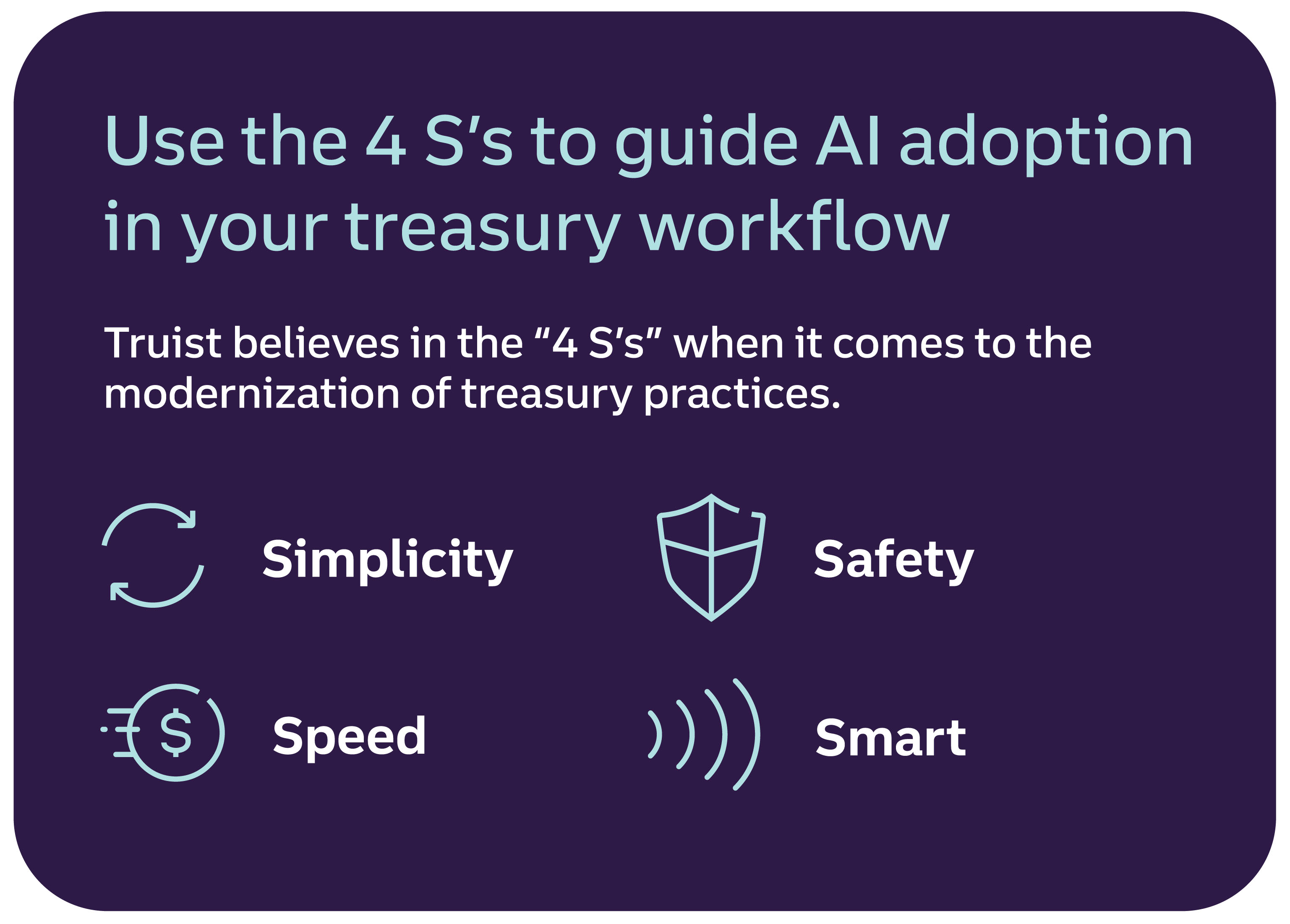
Michael Senuta, Truist’s head of product innovation and partnerships, cites the “4 S’s” of treasury modernization to keep in mind when it comes to AI implementation:

  • Simplicity—reduced manual or repetitive work
  • Safety— enhanced detection capabilities that may help identify potential fraud risks and reduce processing errors
  • Speed—faster access to information
  • Smart—improved forecasting and decision-making
Graphic with this text: Use the 4 S’s to guide AI adoption in your treasury workflow. Truist believes in the “4 S’s” when it comes to the modernization of treasury practices: Simplicity, Safety, Speed, Smart.

“Payments and liquidity are high-impact, time-sensitive functions, so an error turns into immediate losses, failed payments, fraud, or reputational damage,” says Senuta. “Where Truist helps clients is in determining where AI may provide measurable operational benefits depending on implementation and business objectives, versus where it adds unnecessary complexity.”

Where is AI creating real value in treasury?

AI offers the most benefit to treasury managers in data-heavy tasks such as cash forecasting, reconciliation, and payment processing. AI may help improve efficiency and analytical precision when supported by appropriate data quality and controls. It can flag errors and discrepancies, allowing treasury teams to find and correct issues.

“Cash forecasting may become more reliable when supported by high-quality, well-governed data, which can translate into better decisions, not just better reporting,” Senuta says.

That distinction is important: While faster reporting is valuable, the quality of information matters more. When treasury teams have clean and current data flowing into their tools, they can make more informed cash management decisions.

How does AI improve liquidity management and decision timing?

AI’s instant access to information about liquidity and payment optimization may provide enhanced visibility into projected liquidity positions. Instead of reacting to problems when they arise, treasury can better identify and evaluate potential liquidity risks before they occur.

“A treasury team could receive an AI-generated notification early in the day that their operating account is likely to fall below a liquidity threshold later in the day,” Senuta says. “That gives the team the opportunity to prevent last-minute funding scrambles.”

Such alerts might relate to current-day balances, expected cash inflows, payment timing, prior transaction patterns, and established account thresholds.

With that early warning, cash managers could:

  • Resequence non-urgent payments.
  • Move funds between accounts before cut-off times.
  • Avoid last-minute, short-term borrowing.

When timing affects risk and return, advanced insight may help support more informed operational and liquidity management decisions.

How is AI changing the role of treasury teams?

AI can help treasury become more strategic by changing how work is divided between systems and people, says Elliot Cheek, Truist’s head of liquidity. Historically, treasury staff have been responsible for repetitive work such as payment matching and tracking down invoices, as well as checking for errors.

“It’s very challenging to be the doer as well as the reviewer,” Cheek notes. But AI can be far more efficient at data capture and entry, allowing humans to focus on tasks such as exception management and collections. “AI may enable treasury professionals to focus more time on strategic activities and decision support.”

Certain AI solutions may be more adaptable than traditional rule-based tools depending on the use case and implementation. Spreadsheet models and rule-based tools are often limited to doing what they’re told. But AI can learn from changing behavior over time, making it possible to spot timing patterns and payment anomalies that can be easy to miss in a static process.

That advantage offers particular value for payments and fraud mitigation. AI models can learn what “normal” transaction behavior looks like in terms of timing, counterparties, and payment rails, then flag exceptions before payments are released or settled. That may help reduce the likelihood of losses, exceptions, and manual rework.

What makes for a successful AI treasury project?

The key to a successful AI project is to start with focused, measurable uses and resist the urge to pursue AI for its own sake, Cheek says.

“Form a hypothesis, define criteria, and make it measurable and quantitative,” Cheek suggests. “Otherwise, it’s very hard to measure success.”

Every project will be different, and Truist payments specialists can help you customize a plan for using AI in treasury. But you’ll generally:

  • Define a specific use case, such as reconciliation or forecasting.
  • Ensure data used is accurate and relevant.
  • Set measurable success metrics.
  • Test and refine the process before scaling.

Implementation can also require complex data integrations across systems; ongoing coordination among finance, technology, and other departments; and leadership buy-in to manage the change for their teams.

More data is not always better, Cheek adds. Consistent, structured information that reflects actual cash behavior is more valuable than complexity without a clear benefit.

To make the most of AI, track improvements and results. A company might target better forecast accuracy or fewer payment exceptions, for example. Starting with one application that can show measurable results helps organizations build confidence and learn what is required to scale.

What human oversight is needed?

AI can support critical decision-making, but humans still need to make those decisions. The stakes are too high for blind automation, says Senuta. And no matter how advanced AI becomes, company leadership should ensure payments land on time and cash is available when needed.

“If an outcome is hard to reverse or high impact, you have to keep a human in the loop,” Senuta says. “AI can recommend and prioritize, but people should be the ones approving actions.”

That principle gives treasury teams a framework for responsible adoption. Use AI to surface information, prioritize options, and handle repetitive work. Keep human oversight when financial, operational, or reputational risk is high. In practice, that means establishing clear approval authority, model validation, and audit trails so teams understand AI insights and who should act on them.

As AI capabilities evolve, treasury teams that establish strong data foundations and governance today will be better positioned to scale more advanced use cases tomorrow.

Key takeaways

  • AI is improving treasury workflows today.
  • AI can offer better data and earlier visibility.
  • Start with focused, measurable uses.
  • Maintain human oversight in critical functions.

As a treasury leader, you don’t need to navigate AI adoption alone. Truist can help you evaluate where AI belongs in your treasury workflows; identify ways AI may provide operational benefits when implemented with appropriate governance, controls, and risk management practices; and connect those opportunities to available tools and resources. With careful planning and implementation, the result can be a more efficient treasury and better, more confident decisions.

Ready to apply AI to improve visibility, control, and decision-making in your treasury function?

Your Truist relationship manager or Truist treasury specialists can help you plan your AI implementation.

Truist Purple Paper. Developing a treasury ecosystem to propel your business. How a new era of payments technology can transform the way you succeed.
Truist Purple Paper® Developing a treasury ecosystem to propel your business

Learn how a new era of payments technology can transform the way you succeed.

Related resources

Payments Technology Strategies for Business Growth

Payments Technology Strategies for Business Growth

Manage cash flow Payments technology that pays off

Payments technology strategies to help keep your business resilient

Article
06/08/2026
Payments Technology Strategies for Business Growth

Explore payments technology strategies that improve onboarding, modernize payment systems, strengthen customer communication, and reduce fraud risk.

Dropp Employs Real Time Payments® To Power Instant Settlement

Dropp Employs Real Time Payments® To Power Instant Settlement

Client case study Truist delivers payments at the speed of light for Dropp

Instant pay-by-bank platform to send Real-time Payments removes delays and improves cash flow.

Article
03/04/2026
Dropp Employs Real Time Payments® To Power Instant Settlement

See how Truist’s Real-Time Payments (RTP®) solution enables Dropp merchants to receive funds instantly, reduce card fees, and move beyond traditional payment rails.

Can Sweep Solutions Improve Your Business Finances?

Can Sweep Solutions Improve Your Business Finances?

Manage Cash Flow Can sweep solutions improve your business finances?

Idle cash in your operating account could be working harder for your bottom line.

Article
10/30/2025
Can Sweep Solutions Improve Your Business Finances?

Discover how automated sweep solutions can optimize your cash flow by moving idle funds to interest-earning accounts while maintaining liquidity.

    {0}
    {6}
    {7}
    {8}
    {9}
    {12}
    {10}
    {11}

    {3}

    {1}
    {2}
    {7}
    {8}
    {9}
    {10}
    {11}
    {14}
    {12}
    {13}

    Stay informed and get connected

    Looking for fresh thinking and new insights to help uncover opportunities for your business needs?

    Connect with a Relationship Manager

    Work with a partner who sees your vision and has the resources to help you achieve it. We’re ready to focus on the specific needs of your company—and where you are in your business lifecycle.

    *This form is for prospects. Truist clients should contact their relationship manager with inquiries related to commercial products and services.

    Helpful links


    Sign up for monthly articles on Business Insights

    Sign up to receive our business insights, thought leadership, and client success stories that can help inspire your next bold business move.

    Please enter a first name
    Please enter a last name
    Please enter a valid email address
    Please enter a company name
    I'm also interested in: Please select a campaign option