Industry Expertise

K-12 schools take a fresh look at their endowments

Three steps to align endowment strategy with liquidity, investment, and spending needs

K-12 schools are under extraordinary pressure. Tuition increases can’t easily cover rising operational costs without squeezing tuition-paying families and further eroding the enrollment of an already shrinking school-age population. At the same time, these schools are facing demands to enhance their educational offerings, adding amenities to keep up with the competition.

Amid such competing priorities and myriad pressures, schools are considering how their sources of funding—especially endowments—fit into a workable financial plan that provides the liquidity they need. This fresh look offers schools an opportunity to recast their approach to endowment management to meet the new reality.

The search for funds

Operating expenses for K-12 schools reached new heights during COVID and have continued to rise faster than tuition. According to NBOA data, median total operating expenses per student increased 5.4% between FY2023 and FY2024, while the median gap between net tuition and fees per student and total operating expenses per student widened 13.9%.Disclosure 1

Everything is on the table as schools seek to balance expenses and enrollment levels. K-12 schools typically direct 45% of endowments toward maintaining student enrollment through scholarships and need-based financial aidDisclosure 2 . These funds have also provided the capital base that supports long-term institutional sustainability, but endowment draws are increasingly being accessed to support day-to-day operations—now the destination for 30% of endowment support.Disclosure 2

Higher investment portfolio returns from endowments in the past few years—12.3% in 2024 and 11.5% in 2025—have attracted the attention of boards searching for sources of revenue to close budget shortfalls.Disclosure 2 Some schools have reset their endowment policies to increase draws for a limited period while they restructure or work to stabilize the gap between sources and uses of funds. Others have accepted the endowment’s ongoing role in funding operations and begun asking annual fund givers to designate a portion of their gifts for the endowment. Both approaches prompt schools to revisit their financial projections, reassess what they’ll need from endowments, and realign their investment and spending policies to ensure their management approach gets the results required.

3 steps to optimize your endowment approach

Repurposing the endowment beyond its traditional roles of funding financial aid and anchoring long-term capital stability has broad policy implications. Investment policy, spending policy, capital planning, and operating strategy are deeply interconnected, and aligning them will help you use the endowment as a core strategic lever, rather than a standalone asset.

1. Start with your financial projections.

Take an institution-wide look at the next 3-5 years’ inflows and expenses for a baseline understanding of where you’ll need endowment support in key areas such as:

  • Scholarships and financial aid
  • General operations
  • Seeding new programs
  • Capital for maintenance or new facilities
CASH INFLOWS include Tuition & Fees, Contributions/Fundraising, Endowment Net Inflows, Grants, and Athletics 		 CASH OUTFLOWS include Operating Expenses, Debt Service, Capital Expenditures, Student Aid, and Athletics

Segment your cash to guide your funding needs.

Begin by mapping time-sensitive cash projections across three segments: operating cash, reserve cash, and strategic cash needs.

First, calculate the cash you’ll need to meet daily operations. Next, assess amounts needed to protect reserves and fund longer-term uses considering risks, contingencies, and planned projects and investment. You’ll end with three separate buckets:

  1. Operating cash for day-to-day needs
  2. Reserve cash for needs that will occur 6 to 12 months down the road
  3. Strategic cash for needs a year or more out
For operating cash, liquidity is a priority for meeting day-to-day business operating needs.	Cash management is the objective. For reserve cash, principal protection and short-term liquidity with enhanced returns are priorities. Enhanced cash management is the objective. For strategic cash, Yield and total returns are a priority with investment horizons that can exceed a year. Short-term fixed income is the objective.

The resulting cash segmentation should account for planned events, such as seasonality with tuition inflows, while protecting liquidity for unexpected events, like economic downturns or pandemics.

Model scenarios that the endowment may be asked to cover. Financial projections and cash segmentation should point out gaps in where you’ll need endowment draws in the coming years, giving you a more objective view. Remember to account for structural deficits, one-time needs during a period of reset, or strategic investments planned over the coming years.

2. Revisit your investment policy. 

Once you have a clear picture of where you’ll need endowment support, you can revisit your investment policy statement. The guidance it provides on your portfolio mix, risk tolerance, liquidity, and return objectives should align to the endowment's evolving role.

As you evaluate investment options, stress-test your endowment strategy under adverse market and enrollment scenarios to understand how lower investment returns or declining enrollment could affect future spending capacity. Monte Carlo simulations are a valuable tool for this analysis, allowing you or your investment advisors to model hundreds of different combinations of market and economic conditions, to evaluate various investment approaches and asset class combinations and determine the probability that a given portfolio structure will meet your endowment performance goals. From that data, you can construct a portfolio mix that offers a level of risk and potential returns that are appropriate for your institution.

Investment and liquidity decisions depend on a clear articulation of your spending policies, whether managing one-time draws to cover budget shortfalls or meeting annual financial aid or operations support. This also provides the governance guardrails that ensure endowment draws support strategic priorities rather than masking persistent operating deficits. Maintain discipline as excess returns drawn during high-return years may not be available during a down market when you really need them.

At a time when markets are becoming more complex and economic conditions more volatile, the partnership offered by the OCIO model recognizes the vital role endowments play in your school’s financial picture.

3. Consider your options for endowment investment management.

As institutions look to boost endowment income, outcomes often depend on the quality investment managers or advisors provide in guiding financial decisions and securing the sustainability of assets while responding effectively to market events.

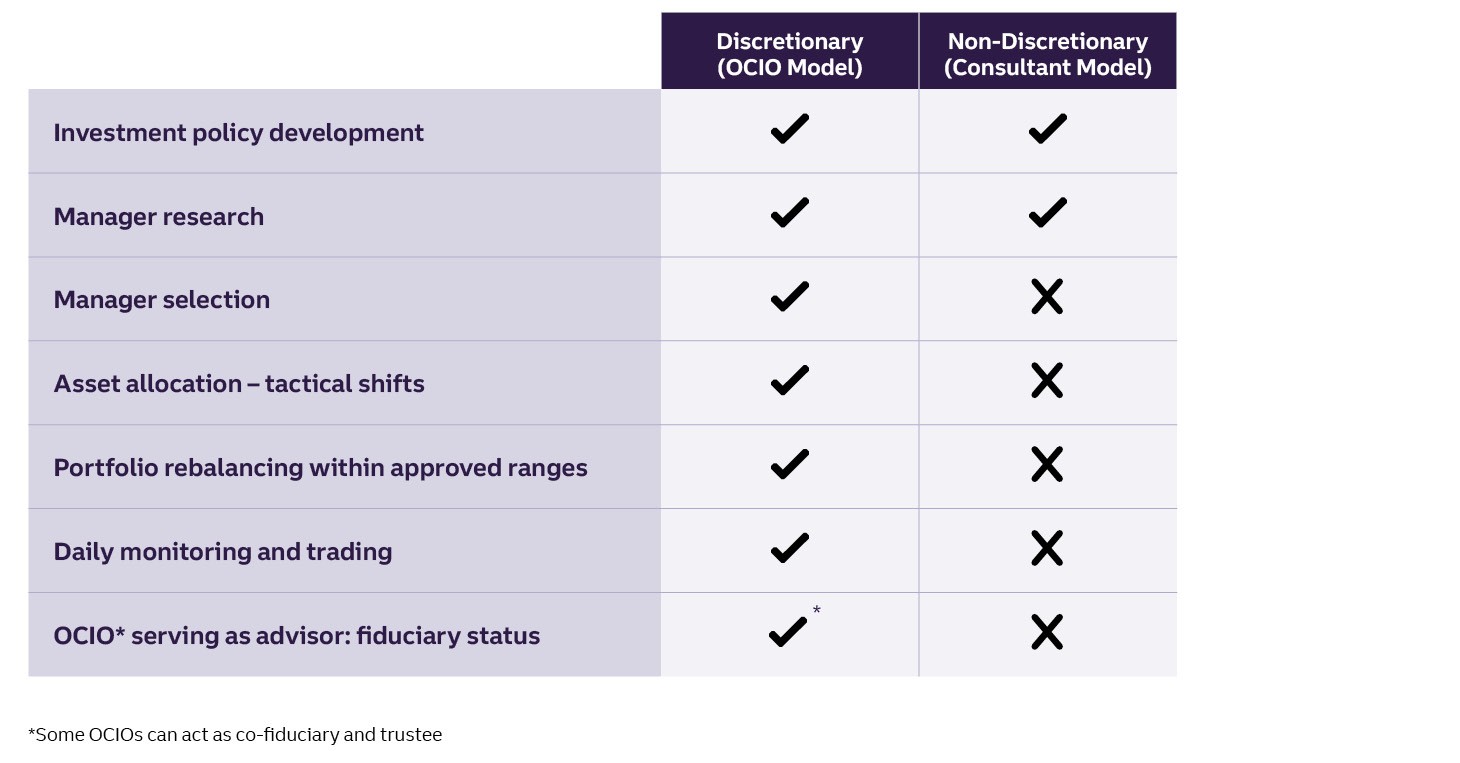
Investment professionals will work with you under either a discretionary or a non-discretionary model. Under the discretionary or Outsourced Chief Investment Officer (OCIO) model, your investment manager makes investment decisions that align with your investment policy on behalf of your institution. With the non-discretionary model or consultant model, an investment advisor provides advice and guidance to your board or investment committee and then executes based on decisions they make.

Investment advisory service models 

Discretionary (OCIO Model) includes Investment policy development, Manager research/selection, Asset allocation – tactical shifts, Portfolio rebalancing within approved ranges, Daily monitoring and trading and OCIO* serving as advisor/fiduciary.  Non-Discretionary (Consultant Model) includes Investment policy development and Manager research.  It does not include Manager selection, Asset allocation – tactical shifts, Portfolio rebalancing within approved ranges, Daily monitoring and trading and OCIO* serving as advisor/fiduciary.

At a time when markets are becoming more complex and economic conditions more volatile, the partnership offered by the OCIO model recognizes the vital role endowments play in your school’s financial picture. Institutions of all sizes are trending toward the OCIO model; it places clear accountability for investment decisions with professional managers and provides them with the discretion to respond quickly to changing financial conditions.

Get the best advice and management for your endowment.

By its nature, the OCIO model can provide a powerful investment platform to help secure the investment returns you need. When reviewing investment advisors and managers, consider:

  • Do they bring substantial experience in the K-12 endowment space and knowledge of its unique challenges and opportunities?
  • Do they specialize in serving institutions of comparable size?
  • Do they offer open architecture (both in-house and third-party products and services) for endowment investment choices?
  • Are the investment recommendations conflict-free (i.e., not exclusively proprietary)?
  • Do they utilize appropriate benchmarks to evaluate endowment performance and identify best-fit investment vehicles?
  • Are they adept at tailoring guidance to align with institutional values?

Fees are important as well. Scrutinize a proposed fee structure to reveal costly investment vehicles or hidden fees, both of which can erode net endowment returns.

Manage your endowment to get the support your school needs.

Endowments are vital in fulfilling a school’s enrollment goals, covering its operating expenses, and sustaining its financial foundation. Our OCIO solution is delivered by Truist Institutional Investment & Advisory Services, which also offers a range of specialized services tailored to the unique needs of education institutions such as fund accounting, planned giving, and gift clearing. The team works closely with your Truist relationship manager to safeguard your endowment and deliver the results that your school’s financial strategy demands.

Truist Purple PaperSM The power of partnership

Uncover the value of Truist Business Lifecycle Advisory and see how your business can benefit today, tomorrow, and beyond.

Related resources

Cyberattacks threaten educational institutions

Cyberattacks threaten educational institutions

Industry expertise Cyberattacks threaten educational institutions

The threat of cybercrime is on the rise. The defenses you build today and the playbook you create to respond to cybercrime will prepare your business for an attack.

Article
08/18/2025
Cyberattacks threaten educational institutions

The threat of cybercrime is on the rise. The defenses you build today and the playbook you create to respond to cybercrime will prepare your business for an attack.

Colleges Renew Focus on Enrollment Trends

Colleges Renew Focus on Enrollment Trends

Industry expertise Small and mid-sized colleges (re)turn their focus to enrollment trends

Shrinking enrollment and affordability concerns are forcing small and mid-size colleges to rethink and rework their value proposition

Article
09/25/2024
Colleges Renew Focus on Enrollment Trends

Small and mid-sized colleges face hard strategic choices in addressing the negative impacts of the impending “enrollment cliff”.

Short-term investment strategy takes on new urgency

Short-term investment strategy takes on new urgency

Industry expertise Short-term investment strategy takes on new urgency

As rates rise, higher education institutions are looking to their short-term investment strategy to help them manage liquidity, sustain performance, and stay ahead of the cash cycle.

Article
12/20/2023
Short-term investment strategy takes on new urgency

As rates rise, higher education institutions are looking to their short-term investment strategy to help them manage liquidity, sustain performance, and stay ahead of the cash cycle.

    {0}
    {6}
    {7}
    {8}
    {9}
    {12}
    {10}
    {11}

    {3}

    {1}
    {2}
    {7}
    {8}
    {9}
    {10}
    {11}
    {14}
    {12}
    {13}

    Stay informed and get connected

    Looking for fresh thinking and new insights to help uncover opportunities for your business needs?

    Connect with a Relationship Manager

    Work with a partner who sees your vision and has the resources to help you achieve it. We’re ready to focus on the specific needs of your company—and where you are in your business lifecycle.

    Existing Truist clients are encouraged to contact their relationship managers with inquiries related to commercial products and services.

    Helpful links


    Sign up for the K-12 Education Industry Update

    Sign up to receive the K-12 Education Industry Update - straight to your inbox and stay up to date on industry news and trends.

    Please enter a first name
    Please enter a last name
    Please enter a valid email address
    Please enter a company name
    I'm also interested in: Please select a campaign option